Construction
October 6, 2026
DPR for Construction Projects: Meaning, Cost & Components and How to Prepare One
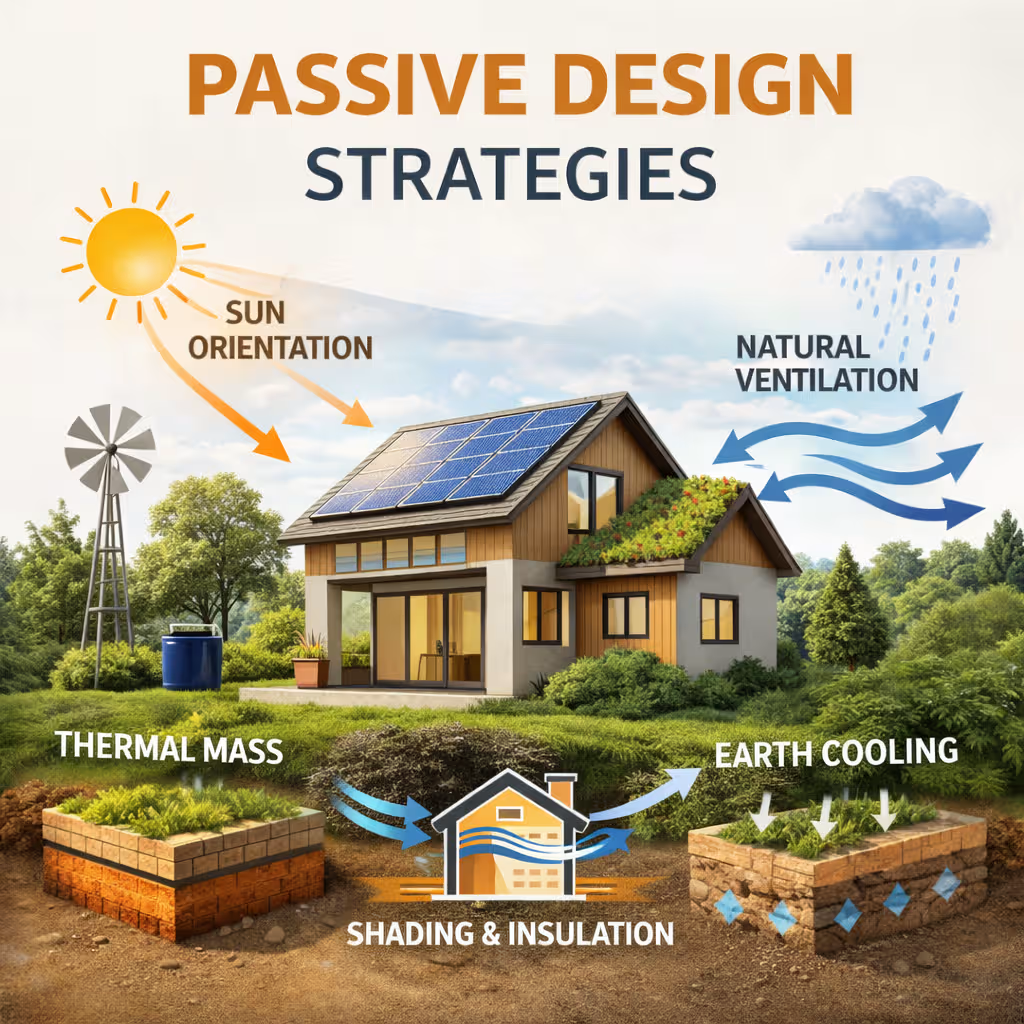
Most buildings attempt to reduce energy bills after construction—by installing larger HVAC systems, automation, or renewable energy add-ons. By that stage, however, 70–80% of a building’s lifetime energy performance is already locked by early design decisions, leaving limited scope for meaningful cost correction.
Passive design works differently. It reduces base energy demand before mechanical systems are sized, by shaping how the building responds to local climate, solar exposure, wind movement, and heat gain. Decisions related to orientation, massing, envelope design, and daylighting are largely irreversible once architectural drawings are finalised.
For projects aiming to control long-term operating costs, indoor thermal comfort, and regulatory compliance, passive design is not a sustainability feature—it is a planning-stage risk management strategy that directly influences HVAC sizing, electrical infrastructure, and lifecycle costs.
.avif)
Passive design does not mean eliminating air-conditioning or replicating vernacular architecture without context. In Indian buildings, it refers to planning-stage design decisions that reduce baseline cooling and lighting demand before HVAC, electrical, and backup systems are sized.
By optimising orientation, envelope performance, daylight access, and airflow paths early, passive design allows active systems to be smaller, cheaper, and more reliable—without compromising operational requirements.
When applied correctly, passive design typically delivers:
Crucially, these gains are achieved without adding operational complexity, automation dependency, or specialised maintenance burdens—making passive design one of the lowest-risk energy optimisation strategies available at the planning stage.
Passive design delivers value only when key decisions are taken before architectural layouts, services, and structure are frozen. Once these parameters are locked, corrective measures become expensive, limited, or ineffective.
Below are the five passive design decisions with the highest long-term impact on energy performance, comfort, and infrastructure cost.
Building orientation is the single most influential passive design decision—and the most difficult to correct later.
In most Indian climates:
Once orientation is fixed, shading devices and high-performance glazing can only reduce damage, not eliminate excess heat gain.
Decision impact: HVAC sizing, glare control, façade cost, daylight quality, long-term energy demand.
.avif)
Building massing determines how efficiently daylight and air move through the structure.
Compact and climate-responsive forms:
Poor massing decisions often result in:
Decision impact: Daylighting efficiency, ventilation potential, internal comfort zoning, future expansion feasibility.
The building envelope controls how much heat enters before any system turns on.
Critical envelope decisions include:
In Indian conditions, roofs alone can account for 20–35% of total heat gain in low-rise buildings if left untreated—making roof design one of the highest-return passive interventions.
Decision impact: Cooling load, indoor temperature stability, HVAC efficiency, operational energy cost.
.avif)
Daylighting is often mistaken for increasing glass area. In practice, uncontrolled glazing frequently raises cooling loads and visual discomfort.
Effective daylighting depends on:
Poor daylighting design leads to:
Decision impact: Lighting energy consumption, occupant comfort, learning and productivity outcomes.
Natural ventilation is not universally applicable and must be evaluated realistically.
It works best in:
It is ineffective or risky when:
Natural ventilation should be treated as a load-reduction strategy, not a replacement for mechanical systems.
Decision impact: Realistic reduction of mechanical dependency, not elimination.
.avif)
Passive design does more than reduce monthly electricity consumption. When integrated at the planning stage, it lowers capital exposure, operational risk, and long-term system dependency benefits that compound across the building’s lifecycle.
What This Means in Practice
These savings are not one-time. They compound over 20–40 years, influencing operating budgets, system longevity, and upgrade cycles.
Passive design is not a substitute for mechanical systems in buildings with high internal loads or strict environmental control requirements. Treating it as a replacement rather than a load-reduction strategy is one of the most common and costly planning mistakes.
Passive design alone is insufficient in:
In such projects, passive strategies play a supporting but essential role. When integrated correctly, they:
The correct approach is sequencing, not substitution: reduce demand first through passive design, then design mechanical systems to meet the remaining load efficiently.
Passive and active strategies serve different roles in building performance. The mistake is not choosing one over the other but choosing them in the wrong sequence.
Passive design reduces baseline energy demand through early planning decisions. Active systems respond to the remaining load after those decisions are locked. Reversing this order almost always leads to oversizing, higher capital cost, and long-term inefficiency.
.avif)
Key Differences That Influence Planning Decisions
The practical rule is simple and consistent across building types: Reduce demand first through passive design. Then optimise active systems to meet the remaining load efficiently.
Q1. What is a passive design strategy in buildings?
A1. A passive design strategy is a planning-stage design approach that reduces a building’s energy demand by responding to climate, sun, wind, and heat before mechanical systems like HVAC are added. It focuses on orientation, massing, envelope design, daylighting, and ventilation to lower cooling and lighting loads naturally.
Q2. What are the five key principles of passive design?
A2. The five core principles of passive design are:
These principles must be decided early, as they cannot be easily changed later.
Q3. How do passive design strategies reduce energy costs?
A3. Passive design strategies reduce energy costs by lowering baseline cooling and lighting demand, which allows HVAC systems, electrical infrastructure, and backup power to be smaller. This reduces upfront construction cost, peak electricity demand charges, and long-term operating expenses.
Q4. Are passive design strategies different for Indian climates?
A4.Yes. Passive design strategies must be adapted to climate zones such as hot-dry, warm-humid, composite, or cold climates. In India, controlling solar heat gain, roof insulation, and ventilation is often more critical than increasing glazing or relying on natural ventilation alone.
Q5. Can passive design replace air-conditioning completely?
A5. No. Passive design does not replace HVAC systems in buildings with high internal loads, such as hospitals, laboratories, or high-density commercial spaces. Instead, it reduces the load that mechanical systems must handle, improving efficiency, reliability, and long-term performance.
Passive design decisions are time-bound. Once orientation, building form, and envelope parameters are finalised, their impact on energy performance and operating cost is permanently locked. These decisions cannot be corrected later without significant cost.
For institutions, NGOs, and developers planning new buildings or major expansions, passive design is not a sustainability add-on. It is a planning-stage cost and risk control strategy that directly affects HVAC sizing, electrical infrastructure, and long-term operational performance.
Plan Early. Avoid Permanent Cost.
BuiltX supports institutions at the planning and pre-design stage to evaluate climate-responsive passive strategies aligned with real operational needs and future growth. Addressing passive design early helps avoid oversized systems, higher capital costs, and long-term inefficiencies. Book your free consultaion now!